2026-10-13 ·
Why Does Your Dryer Take Too Long to Dry Clothes?
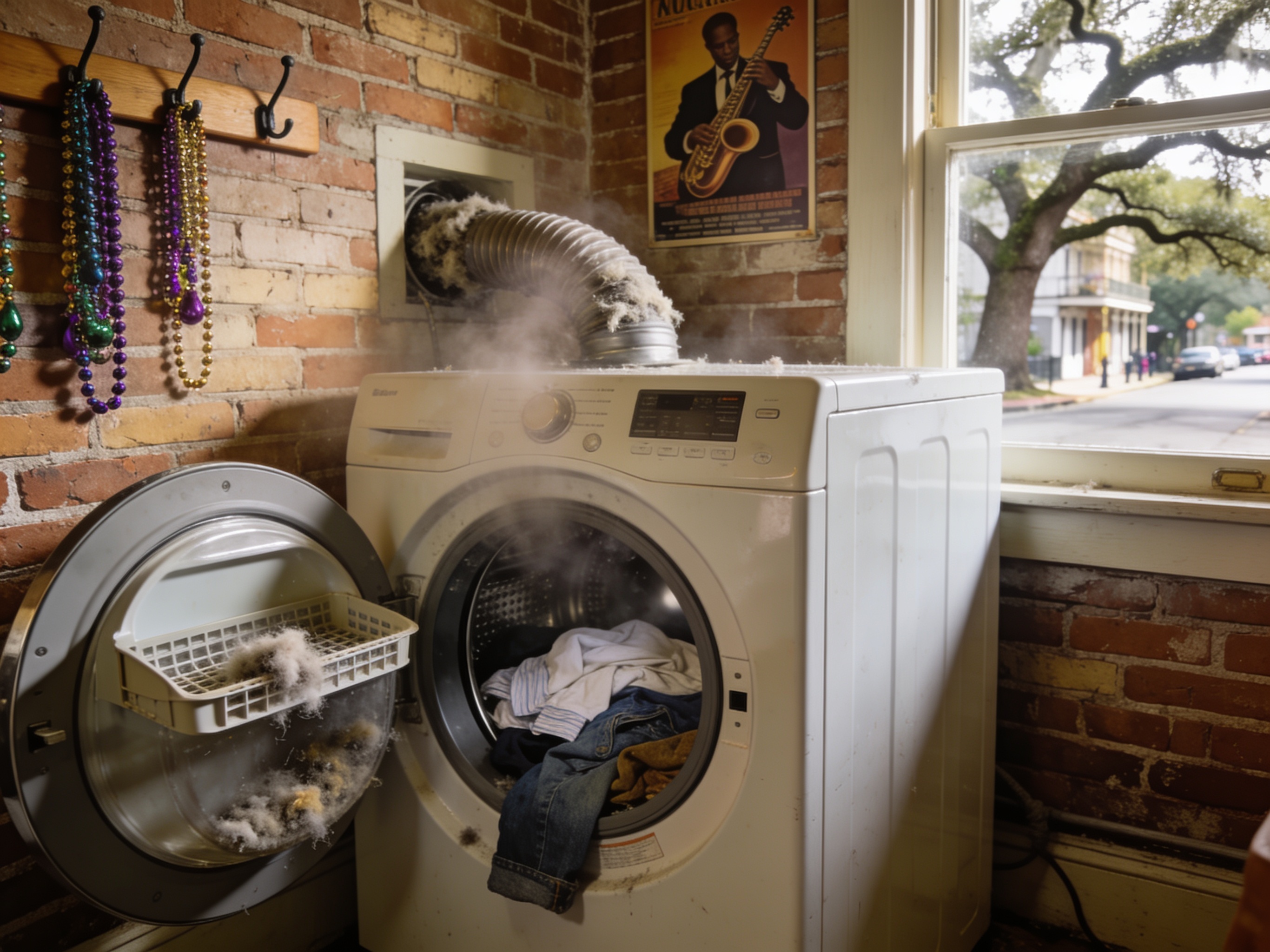
If your dryer in New Orleans runs longer than it should—typically more than 60 minutes for a normal load of everyday laundry—the most common local reason is restricted airflow caused by a clogged vent or lint buildup. In our humid subtropical climate, lint sticks together more easily, and older homes in neighborhoods like the French Quarter, Uptown, and Mid-City often have dryer vents that run through tight crawlspace ceilings or along exterior walls where moisture can accumulate. We see this especially after hurricane season when humidity stays high and homeowners may not notice a gradual blockage until drying times stretch from 30–45 minutes to well over an hour. The fix usually involves cleaning the vent and checking the exhaust path; if the vent is clear, the issue may be the dryer’s internal heating element or thermostat, which can fail after 8–12 years of use. Below we walk through the top three locally relevant causes, how to spot them, and what you can expect in cost and time.
Common Local Causes of Slow Drying
In New Orleans, three factors show up most often in homes across French Quarter, Marigny, Bywater, Uptown, Mid-City, and Algiers:
- Clogged dryer vent or lint trap: Lint builds up in the vent pipe, especially in older homes where the vent runs through unfinished basements or along exterior walls. High humidity makes lint stick together, creating tighter blockages. You’ll notice clothes still feel damp after a full cycle, and the dryer may feel hot but not drying efficiently.
- Age of the dryer: Most residential dryers installed before 2010 have heating elements that lose efficiency after 8–12 years of regular use. In neighborhoods like the Garden District and Gentilly, many houses still have original or second‑generation dryers that approach or exceed this range. If the heating element weakens, the dryer runs longer to reach the target temperature, extending cycle time.
- Poor ventilation or airflow restriction: In tight crawlspace layouts common in pre‑war French Quarter townhouses, the vent may bend sharply or terminate too close to the wall, reducing exhaust flow. After hurricane‑related roof repairs or when exterior walls are sealed, airflow can be further limited. This causes the dryer to work harder, lengthening cycles and increasing indoor humidity.
These issues are more frequent in humid months (May–October) and after heavy rain or storm events when moisture infiltrates vents or causes lint to clump. They’re less common in well‑ventilated newer condos in Uptown or Mid‑City but still possible if the vent was installed poorly.
How to Check for Each Issue (Step‑by‑Step)
- Run the lint trap test: After a short cycle, pull out the lint trap and feel for buildup. If you see more than a thin layer (about the thickness of a credit card), clean it immediately.
- Inspect the vent hose: Disconnect the dryer from power (unplug or turn off at the breaker). Pull the vent hose away from the wall and use a flashlight to look inside. If you can’t see light past the first 12 inches, the vent is likely clogged. A simple vacuum with a long hose attachment often clears minor blockages.
- Check vent termination location: Locate where the vent pipe exits the house. It should exit at least 4 inches above the roofline or sill and not run along an exterior wall where rain can enter. In older homes, you may see the vent ending in a short elbow that sits against the wall—move it outward or add a proper termination cap.
- Test the dryer’s heat: Run a hot‑air only cycle (no clothes) for two minutes. Feel the back of the drum. If it’s warm but not hot (below 140°F), the heating element may be weak. If it’s barely warm, the thermostat or heating coil could be failing. Note: we don’t provide diagnostic codes; a technician will measure resistance if needed.